
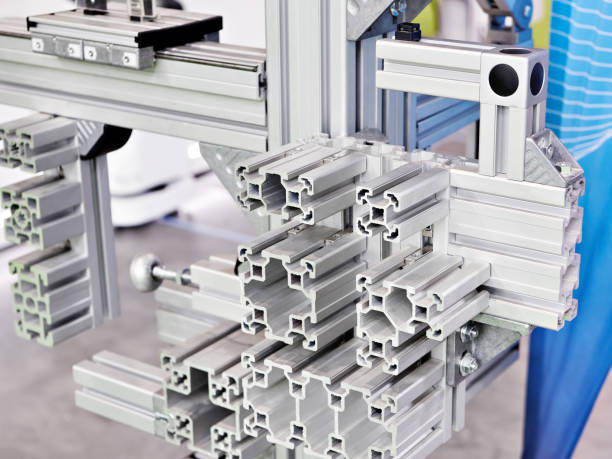

Structural framing has to do more than hold weight after installation. A reliable system must stay stiff, absorb repeated loading, resist permanent deformation, and keep connections aligned as equipment runs. Those mechanical properties explain why high-grade aluminum framing material works so well for machine bases, guards, workstations, conveyors, and industrial structures.
How Much Strength Does the Profile Actually Provide?
Tensile and yield strength describe two different limits designers need to understand. Measured tensile strength shows how much pulling stress aluminum can withstand before failure, while yield strength marks the point where permanent deformation begins. For framing, yield strength often matters first because a rail that stays bent after an overload may no longer keep doors, sensors, or equipment aligned. Profile geometry also changes how those properties translate into frame capacity. Larger sections, internal ribs, and deeper cross sections can carry more demanding loads with the same alloy. Properly selected MiniTec Aluminum Framing combines material strength with profile shape instead of relying on alloy rating alone.
Stiffness Matters Before the Frame Reaches Its Limit
Elastic modulus describes how strongly a material resists stretching or bending within its elastic range. Aluminum is less stiff than steel, so an aluminum member generally needs the right cross-sectional geometry to control deflection over longer spans. That does not make the material weak. Instead, engineers use section depth, moment of inertia, support spacing, and bracing to keep movement within application limits.
Deflection can become a problem long before an extruded aluminum T slot profile approaches failure. Small amounts of sag may affect conveyor tracking, linear slides, inspection fixtures, or machine guards with close door clearances. Careful sizing of MiniTec extruded aluminum framing helps the structure stay straight enough for supported equipment.
Strength-to-Weight Ratio Keeps Industrial Structures Efficient
Low density gives aluminum a strong advantage where frames need useful load capacity without excessive mass. Compared with steel, aluminum weighs much less by volume, which can make large assemblies easier to carry, position, and modify on factory floors. Mobile carts and adjustable workstations benefit directly because lower frame weight leaves more of the caster capacity available for tools and equipment. Good design still avoids treating lightweight construction as an excuse to undersize the structure. Correct profile selection lets a T slot extrusion frame place material where stiffness is needed while keeping less heavily loaded sections compact.
Fatigue Resistance Becomes Important Around Moving Equipment
Repeated forces deserve a different review from a single static load. Motors, conveyors, pneumatic cylinders, robotic devices, and sliding assemblies can create thousands of stress cycles during normal daily production. Even forces well below the maximum strength of a profile may eventually affect joints or highly stressed areas if vibration continues for years.
Fatigue performance depends on stress range, connection design, surface condition, and the location of concentrated loads. Sharp transitions, loose fasteners, or poorly supported brackets can create local stress that the main rail rating does not reveal. Reinforcement around moving equipment can help an aluminum framing kit maintain alignment through repeated starts, stops, and reversals.
Ductility Helps Aluminum Handle Real-World Stress
Ductility allows aluminum to deform to a degree before fracture rather than behaving like a brittle material. Such behavior gives fabricators useful flexibility during machining and can provide visible evidence of overload before a member fails completely. Industrial frames still should never depend on permanent bending as a safety feature, but predictable deformation helps engineers understand how the structure may respond under overload. Machining holes, cutting profiles, and preparing mounting features also benefit from aluminum’s workable nature. Well-designed T slot aluminium extrusion preserves enough material around fasteners and machined areas so those local changes do not create weak sections.
Hardness and Joint Contact Affect Long-Term Performance
Surface hardness influences how well contact areas tolerate repeated tightening, sliding hardware, and everyday handling. T-slot nuts, brackets, and connecting plates transfer force through small regions, so excessive torque or undersized hardware can damage slot edges even when the main profile remains sound. Matching fasteners to the profile spreads clamping force more effectively and protects the mounting surface.
Wear becomes especially relevant on structures that receive frequent adjustments. Repeatedly moving brackets, doors, or accessories along one slot can mark contact surfaces over time. Proper torque, clean hardware, and compatible components help MiniTec Aluminum Framing retain secure mounting points without unnecessary damage.
Torsional Strength Keeps the Complete Frame Working as One
Twisting forces appear when loads sit off center, doors swing from one side, or equipment pushes across the frame instead of straight through it. Rectangular structures can rack if corners and cross members do not provide enough rotational stiffness, even though each individual profile is strong in simple bending. Braces, gussets, wider bases, and stronger connectors help control that motion while preserving the adjustable nature of the system. Engineers should look at the whole load path, including anchors and joint stiffness, rather than checking one rail in isolation. MiniTec Solutions provides profile choices, compatible connection hardware, and modular framing options that help manufacturers match mechanical performance to the actual weight, motion, span, and service conditions of an industrial build.