
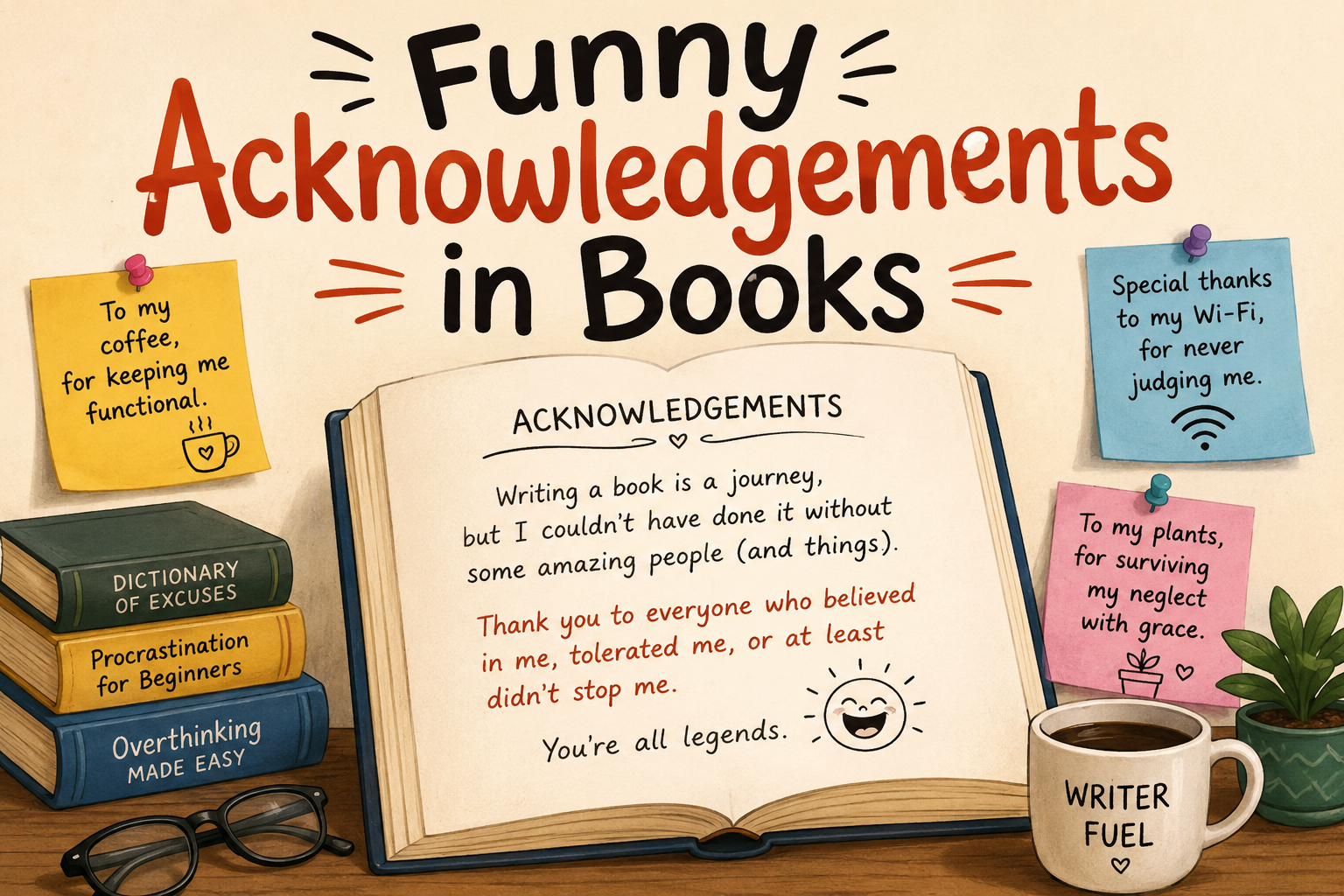

Why Readers Love a Funny Acknowledgements Page
The acknowledgements section is often the most human part of a book — a brief, unfiltered moment where an author steps away from their carefully crafted narrative voice and speaks directly, informally, to the people who supported them. When done with humour, this section tends to stick with readers long after they’ve forgotten smaller plot details, precisely because it feels so genuinely personal.
A funny acknowledgements page also does something subtle but valuable: it humanises the author. Readers who enjoy a writer’s humour in their acknowledgements often develop a warmer, more personal connection to that author’s future work, since the joke reveals a bit of real personality behind the polished prose.
Common Themes in Funny Acknowledgements
A recurring theme in humorous acknowledgements is self-deprecation — authors poking fun at how long the book took to write, how many drafts were scrapped, or how their coffee consumption spiralled out of control during the writing process. This kind of honest, exaggerated confession tends to resonate because most readers can imagine how genuinely difficult finishing a book actually is.
Another common approach is thanking pets, inanimate objects, or absurd non-contributors with mock sincerity — crediting a cat for ’emotional support despite walking across the keyboard constantly’ or thanking a specific coffee shop chair for ‘structural support during eleven consecutive drafts.’ This kind of playful exaggeration works because it subverts the reader’s expectation of a formal, serious thank-you list.
Balancing Humour With Genuine Gratitude
The best funny acknowledgements manage to be genuinely funny without undermining the sincerity of the thanks being given. A joke about a spouse’s patience during late-night writing sessions still needs to land as authentically appreciative underneath the humour, or it risks feeling glib rather than warm.
A common structural approach is opening with a joke to set a light tone, then transitioning into more sincere, direct thanks for the people who mattered most — editors, family, mentors — closing the section on a genuine note even if the overall tone stayed playful throughout.
Tips for Writing Your Own Funny Acknowledgements
Start by genuinely reflecting on the writing process itself — the specific, slightly ridiculous moments that happened along the way tend to make for far better material than generic jokes borrowed from other books. A specific, true anecdote about a chaotic edit or a supportive friend’s odd habit will almost always land better than a generic joke that could apply to any book.
It also helps to read your draft acknowledgements out loud before finalising them. Jokes that read as clever on the page sometimes fall flat or feel awkward when spoken aloud, and reading aloud is often the fastest way to catch a joke that isn’t quite landing as intended.
Knowing When to Dial the Humour Back
Not every book calls for a purely comedic acknowledgements section — a memoir dealing with difficult personal material, for instance, might use only light, gentle humour rather than an extended comedic bit, to avoid undercutting the emotional tone the book has otherwise established.
Matching the acknowledgements’ tone to the overall spirit of the book tends to feel more coherent to readers than a jarring tonal shift, even if a slightly humorous note is still entirely appropriate even for more serious books, provided it’s handled with a light touch rather than an extended comedic routine.
A Few Structural Approaches That Work Well
Some authors organise funny acknowledgements chronologically, walking through the writing journey from initial idea to final draft with a joke or observation at each stage. Others prefer a more list-based approach, thanking individuals and things in quick succession with a punchline attached to each entry, which tends to create a rapid, engaging rhythm that’s easy to read in one sitting.
Whichever structure is chosen, keeping the section reasonably concise tends to work better than an overly long comedic acknowledgements page — readers generally appreciate a short, memorable read over an extended one that risks losing its comedic momentum partway through.
Learning From What Makes These Pages Memorable
Readers who enjoy collecting or sharing favourite funny acknowledgements pages tend to gravitate toward ones with a genuinely surprising twist — an unexpected thank-you that subverts what the reader assumed was coming, or a callback earlier in the acknowledgements that pays off unexpectedly by the final line. This kind of structural surprise tends to be what makes a particular acknowledgements page memorable enough to be quoted or shared independently of the book itself.
Studying a handful of acknowledgements pages you personally found memorable, and noting specifically what made them work — the timing, the specificity of the joke, the balance between humour and sincerity — can be a genuinely useful exercise before sitting down to write your own.
Final Thoughts
Funny acknowledgements in books offer authors a rare chance to speak directly and informally to readers, and when done well, they leave a genuinely memorable impression that outlasts many other parts of the book. Balancing real humour with authentic gratitude, grounded in specific true details from the writing journey, tends to produce the acknowledgements pages readers remember and quote long after finishing the book.